Back to: Teacher Development: Consciousness Education
You might be wondering, ‘What is consciousness education?’ We define Consciousness Education as an exploration of perspectives on the source and nature of consciousness, and its implications for being, knowing, teaching and learning.
The Consciousness Education Project has identified seven core principles of Consciousness Education. These principles are offered as guides rather than prescriptions. They describe an approach to education that emerges from and contributes to a new paradigm for understanding consciousness. These principles are not intended to be a fixed framework or belief system; they are open to further shaping by those exploring Consciousness Education in different contexts and cultures.
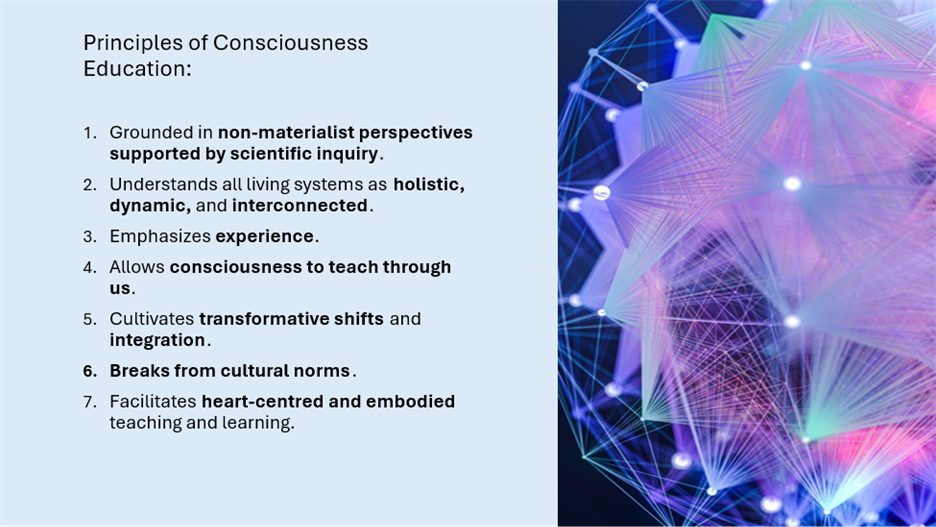
These principles help distinguish consciousness education from other educational initiatives that may be related but do not necessarily focus on shifting assumptions about consciousness. Examples of such initiatives might include contemplative education, holistic education, mindfulness-based interventions, education that includes cultural, spiritual or religious traditions such as Yoga or Indigenous education, arts- or nature-based pedagogies, and social and emotional learning. These approaches are valuable and often powerful for promoting well-being, transformative learning, and culturally relevant pedagogies, and they may offer tools to help with consciousness education. However, educators in such programs may not necessarily be engaging in consciousness education.
Just as it is possible to weave social and emotional learning into a curriculum without being explicit, it is possible to weave aspects of consciousness education into a curriculum without being explicit. You may find, as you take this course, that just as talking about SEL changes how students and teachers engage with emotions, foregrounding consciousness changes how teachers and students engage with each other and the material.